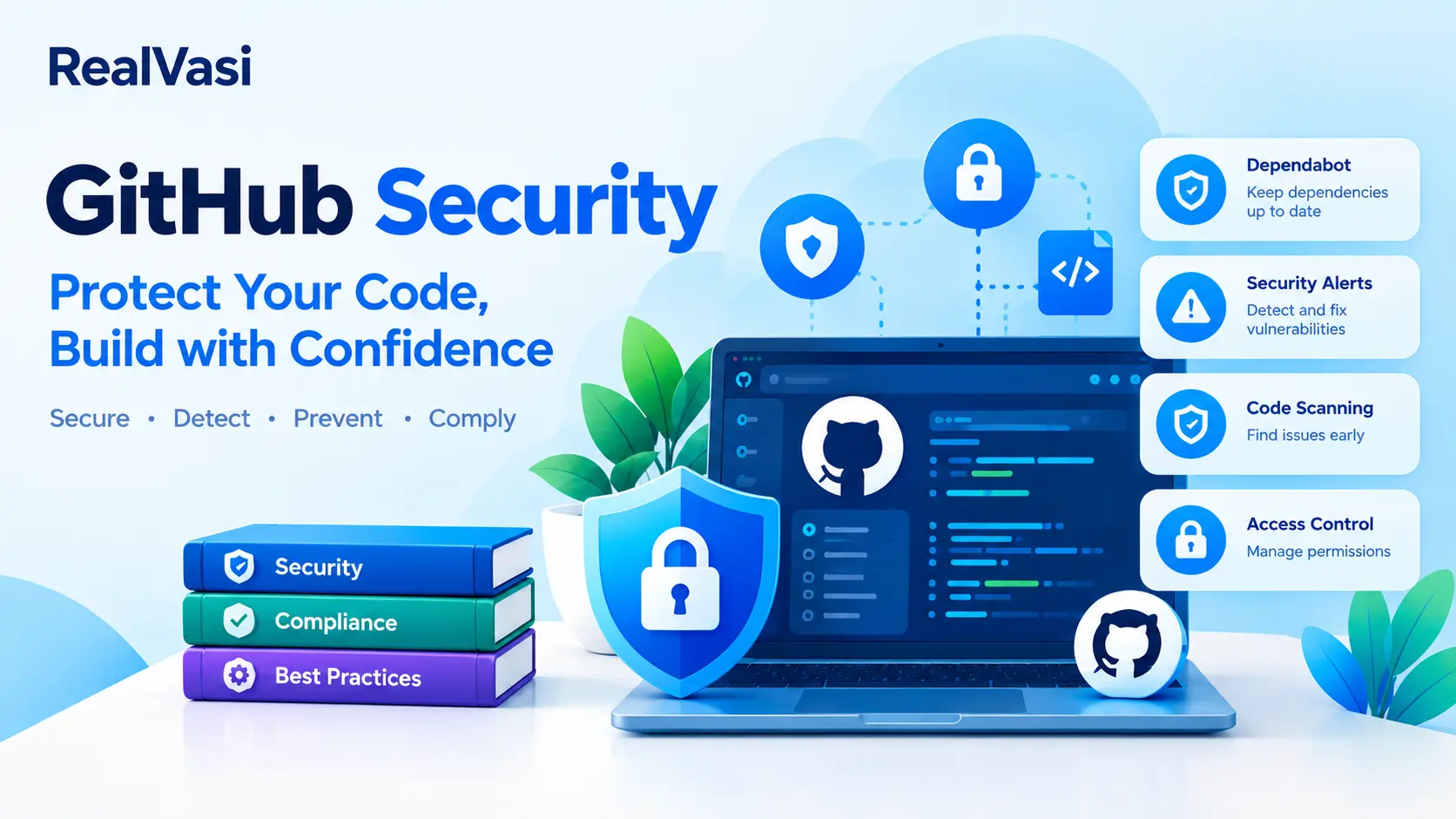
GitHub Security Features
Security is an important part of modern software development, particularly when source code, dependencies, credentials, and development workflows are managed through a shared platform.
GitHub provides several security capabilities that can help developers and organizations:
- Protect repository access
- Identify vulnerable dependencies
- Detect exposed secrets
- Analyze source code for potential security issues
- Monitor security alerts
- Establish controls around important code
- Integrate security checks into the development workflow
The exact security capabilities available can depend on repository configuration, organization settings, and GitHub plan.
The important idea is that security should not be treated as an activity that happens only after development is complete.
Instead:
Design
↓
Develop
↓
Commit / Pull Request
↓
Automated Checks
↓
Security Analysis
↓
Review
↓
Merge
↓
Deployment
Security can therefore become part of the software-development lifecycle rather than a final activity performed immediately before deployment.
Why GitHub Security Matters
Modern applications rarely consist entirely of code written by one development team.
A typical application may depend on:
- Open-source libraries
- Package managers
- External APIs
- Container images
- Cloud services
- CI/CD workflows
- Third-party development tools
At the same time, repositories may contain or provide access to sensitive resources.
This creates several potential security concerns:
Source Code
│
├── Dependencies
├── Credentials
├── Deployment Workflows
└── Infrastructure Configuration
↓
Security Risk
GitHub’s security capabilities address different parts of this environment. The objective is not simply to find security problems. It is to introduce appropriate controls that help prevent, detect, investigate, and respond to security issues.
Repository Access and Security Controls
Controlling who can access a repository is one of the basic elements of protecting source code.
GitHub provides repository- and organization-level controls that allow teams to manage who can:
- View repositories
- Modify code
- Collaborate on development
- Administer projects and repositories
For development teams, access should generally follow the principle of giving people only the permissions they require for their responsibilities.
A simple model is:
Repository
↓
Access Control
↓
Appropriate Permissions
↓
Developers / Reviewers / Administrators
Not every contributor needs administrative access. Restricting unnecessary permissions can reduce the impact of accidental or unauthorized changes.
Repository Rules and Protection
Organizations can establish repository rules and rulesets to define requirements for important branches and tags.
For example, a team may require:
- Specific automated checks
- Required approvals
- Conditions before merging changes
- Protection of important branches
This creates a controlled path for introducing changes into critical parts of a repository.
GitHub Security is not only about detecting vulnerabilities. Teams also need controls around how changes enter important branches.
For example:
Feature branch → Pull request → Required review → Automated checks → Security checks → Merge
This creates a structured path for introducing changes into important branches.
Dependency Security
Modern applications commonly depend on external packages and libraries. A vulnerability in one of these dependencies can potentially affect the application using it.
This is why application GitHub security is not limited to code written directly by the development team.
Dependency Graph
GitHub’s dependency graph helps developers understand the packages and libraries used by a repository.
It provides visibility into the project’s dependency network and supports other GitHub security capabilities, including Dependabot.
Understanding dependencies is an important part of modern software supply-chain security.
Dependabot
Dependabot helps developers identify vulnerable or outdated dependencies and can assist with keeping those dependencies updated.
When a known vulnerability is associated with a dependency, Dependabot can alert the development team so the issue can be investigated and addressed.
When appropriate security updates are available, Dependabot can also create pull requests for dependency updates.
A simplified process is:
Vulnerable Dependency
↓
Security Alert
↓
Updated Version Identified
↓
Pull Request
↓
Developer Review
↓
Tests
↓
Merge
This can reduce the manual effort involved in continuously monitoring third-party dependencies. However, dependency updates should still be reviewed and tested because changing a package version can affect application behavior.
Secret Scanning and Credential Protection
Repositories can sometimes accidentally contain sensitive information such as:
- API keys
- Access tokens
- Passwords
- Authentication credentials
- Private keys
- Other supported secrets
Accidentally committing such information can create a serious security risk.
GitHub’s secret scanning capability can help detect supported exposed credentials and other secret types in repositories.
When a supported secret is detected, GitHub can generate an alert so the development team can investigate and respond.
A basic workflow is:
Secret Accidentally Committed
↓
Secret Scanning
↓
Alert
↓
Investigation
↓
Credential Revocation / Remediation
GitHub also provides push protection, which can help prevent supported secrets from reaching a repository in the first place.
The important principle is: Secret-scanning capabilities should be treated as a defensive layer, not as a reason to store credentials in source code.
The preferred approach is to prevent secrets from entering repositories and use appropriate secret-management mechanisms when applications or workflows need access to sensitive values.
If a credential has already been exposed, simply deleting it from the latest version of a file may not be sufficient. Appropriate remediation may require revoking or rotating the credential.
Code Scanning
Code scanning analyzes source code to identify potential security vulnerabilities and coding problems.
GitHub supports code scanning using technologies such as CodeQL, which can analyze supported programming languages and identify potential security issues.
Code scanning can be integrated into the development and code-review workflow.
For example:
Pull Request
↓
Code Scanning
↓
Potential Issue Detected
↓
Alert
↓
Developer Investigation
↓
Fix
↓
Validation
This allows security analysis to become part of normal development rather than being performed only after development is complete.
The detailed configuration and implementation of CodeQL and other code-scanning technologies are better suited to a dedicated GitHub security guide.
Dependency Review
Dependency changes should also be evaluated before they become part of the project.
GitHub’s dependency review capability can provide information about dependency changes in pull requests and help identify potentially vulnerable dependency versions before those changes are merged.
For example:
Pull Request
↓
Dependency Changed
↓
Dependency Review
↓
Potential Vulnerability
↓
Developer Review
↓
Decision
↓
Merge / Change Dependency
This provides another layer of protection for the software supply chain.
Security Alerts and Advisories
Open-source projects sometimes need a controlled way to investigate and communicate vulnerabilities.
GitHub provides security advisories that can allow maintainers to privately discuss and address vulnerabilities before information is published more broadly.
A repository can also include a security policy explaining how security vulnerabilities should be reported.
A clearly defined reporting process gives researchers and users a responsible way to communicate potential vulnerabilities instead of publicly exposing sensitive technical details.
This can be particularly important for open-source projects used by other developers and organizations.
Software Supply Chain Security
The security of a modern application extends beyond its own source code.
A project may depend on:
Application
↓
Open-Source Libraries
↓
Package Registry
↓
Build System
↓
Deployment Environment
↓
Production Application
This broader chain is often referred to as the software supply chain.
GitHub provides several capabilities that address different parts of this area, including:
- Dependency graph
- Dependabot alerts
- Dependabot security updates
- Dependency review
- Secret scanning
- Code scanning
- Security advisories
- Artifact attestations
The objective is to introduce appropriate security checks at different points throughout the development lifecycle.
GitHub Security and Pull Requests
Many security capabilities become particularly useful when integrated with pull requests.
A development team could use a workflow such as:
Developer Creates Code
↓
Pull Request
↓
Dependency Review
↓
Code Scanning
↓
Secret Detection
↓
Automated Tests
↓
Required Reviews
↓
Merge
After the code is merged, dependency monitoring can continue and alert the team when new vulnerabilities are discovered.
This creates a more continuous security process rather than relying only on occasional manual security reviews.
A Practical GitHub Security Workflow
The various capabilities can be viewed as layers:
Access Control
↓
Repository Rules
↓
Secure Development
↓
Dependency Monitoring
↓
Secret Protection
↓
Code Scanning
↓
Code Review
↓
Secure Deployment
No individual security feature provides complete protection. Instead, different controls address different types of risk.
This layered approach is particularly important for production systems and applications handling sensitive data.
Real-World Example
Consider a team developing an e-commerce application.
A developer introduces a third-party package for a new feature and submits the change through a pull request.
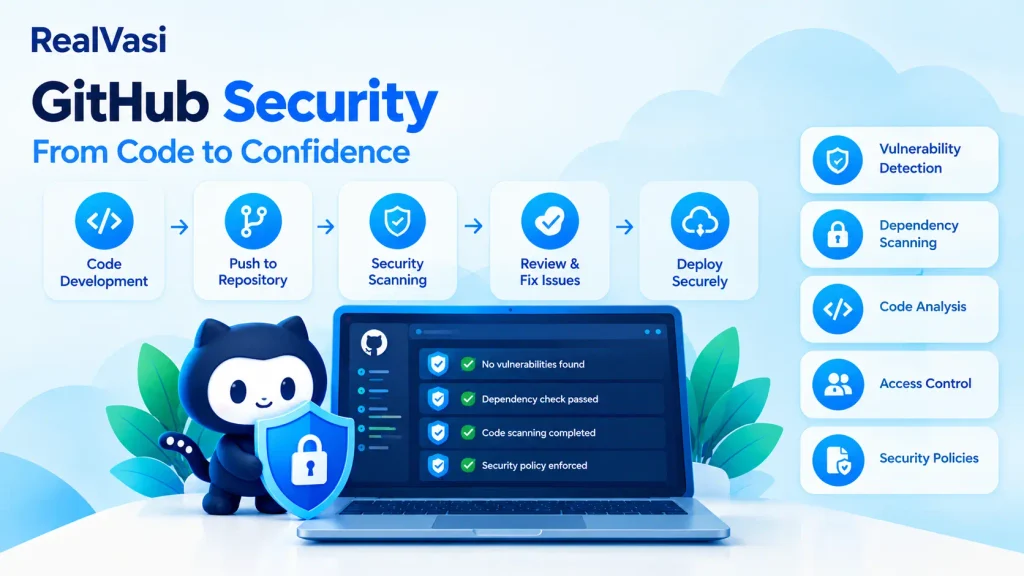
The team’s GitHub workflow could perform:
Pull Request Created
↓
Dependency Review
↓
Code Scanning
↓
Secret Detection
↓
Automated Tests
↓
Code Review
↓
Merge
Suppose the new dependency has a known security vulnerability. Dependency-related security tooling can alert the development team before the change becomes part of the production branch.
Similarly, if a developer accidentally includes a supported API credential in a commit, secret-protection mechanisms may identify or prevent the exposure.
This demonstrates an important principle: Security can be incorporated into normal development activities rather than handled as a completely separate process.
Benefits of GitHub Security Features
Earlier Vulnerability Detection
Security issues can be identified during development rather than only after deployment.
Dependency Visibility
Teams can understand which external packages and libraries their applications depend on.
Reduced Credential Exposure
Secret scanning and push protection can help detect or prevent accidental credential exposure.
Automated Dependency Maintenance
Dependabot can help identify vulnerable or outdated dependencies and automate parts of the update process.
Integrated Security Workflows
Security checks can be incorporated into pull requests and other development activities.
Better Security Governance
Repository rulesets and organizational controls can help teams establish consistent development practices across repositories.
Security Practices Developers Should Follow
GitHub’s security tools are most effective when combined with good development practices.
- Avoid committing passwords, API keys, tokens, or private keys to repositories.
- Use appropriate secret-management mechanisms.
- Keep dependencies updated.
- Review dependency changes carefully.
- Enable appropriate security scanning for the repository.
- Review security alerts regularly.
- Use protected branches or rulesets for important code.
- Require appropriate code reviews.
- Keep development and deployment permissions appropriately restricted.
- Investigate security alerts rather than simply dismissing them without review.
Security should be treated as an ongoing part of software development rather than a one-time activity.
GitHub Security Is Not a Replacement for Application Security
It is important to understand the boundary of GitHub’s security capabilities.
GitHub can provide valuable controls around:
- Source repositories
- Dependencies
- Credentials
- Code
- Collaboration
- Development workflows
But a secure GitHub repository does not automatically mean that the application itself is secure.
Developers still need to consider application-level concerns such as:
- Authentication
- Authorization
- Input validation
- Data protection
- Secure API design
- Infrastructure security
- Secure deployment
- Runtime monitoring
GitHub security capabilities should therefore be considered part of a broader security strategy.
RealVasi Expert Perspective
Effective security practices need to be incorporated into each stage of building, testing, deploying, and maintaining software.
For development teams, enabling every available security feature is not necessarily the objective.
The more important goal is to identify the security controls appropriate for the project’s:
- Architecture
- Data
- Dependencies
- Deployment model
- Team structure
- Risk profile
A practical approach is:
Access Control
↓
Secure Development
↓
Dependency Monitoring
↓
Secret Protection
↓
Code Scanning
↓
Code Review
↓
Secure Deployment
Automated tools are not a replacement for engineering judgment.
Security alerts need to be reviewed, risks need to be prioritized, and fixes need to be validated before they are introduced into production systems.
For teams working with open-source dependencies and cloud-based development workflows, integrating appropriate security checks directly into GitHub can help make security a continuous part of the software development process.
The objective should therefore be:
Secure by Design → Detect Early → Review Carefully → Fix Appropriately → Validate Continuously
Key Takeaway
GitHub provides a collection of security capabilities that can help teams protect repositories, dependencies, credentials, code, and development workflows.
The major concepts covered in this guide can be summarized as:
Repository Access
↓
Rules and Protection
↓
Dependency Management
↓
Secret Protection
↓
Code Scanning
↓
Dependency Review
↓
Code Review
↓
Secure Delivery
Some of the most important capabilities include:
- Repository access controls and rules
- Dependency graph
- Dependabot
- Secret scanning
- Push protection
- Secure secret management
- Code scanning
- Dependency review
- Security advisories
- Security alerts
However, these capabilities work best when combined with sound engineering practices.
The goal is not to enable every available security feature simply because it exists. The goal is to establish the right security controls for the project’s requirements and risk profile.
A secure development workflow is therefore not a single tool or feature. It is a continuous process that brings together:
People + Process + Code + Automation + Security Controls
GitHub can provide important security capabilities throughout this process, but effective security ultimately depends on how those capabilities are selected, configured, monitored, and combined with sound engineering practices.